
Responsibilities
ALL WORKERS
- Report hazards, near misses, and incidents to their supervisor and the HY project team.
- Participate in investigations or learning conversations when requested.
PROJECT TEAM LEADERS
- Ensure incidents are reported and recorded in HammerTech.
- Support the planning and execution of investigations, where relevant.
- Implement and monitor corrective actions arising from investigations.
- Share relevant learnings with other teams or projects to support continuous improvement.
ACCOUNTABLE MANAGER
- Review investigation findings and ensure they are tabled at the fortnightly Incident Review Group.
- Consult on and endorse corrective actions that address root causes.
- Monitor close-out of corrective actions, particularly those with organisation-wide or systemic implications.
INVESTIGATION LEAD
- Plan and lead the investigation using the approved methodology.
- Collect and analyse evidence to identify contributing factors and root causes.
- Summarise findings and recommendations, and communicate these to the Accountable Manager and relevant stakeholders.
HSE MANAGER
- Support event classification in line with the Event Learning Procedure.
- Provide guidance to the Investigation Lead during investigation planning and execution.
- Support the Accountable Manager and project team in applying and verifying corrective actions, where required.
FORTNIGHTLY INCIDENT REVIEW GROUP
- Review recent events and investigations from across the business.
- Table findings and recommendations for discussion.
- Monitor the progress and close-out of corrective actions, focusing on organisational and systemic learnings.
ALL WORKERS
- Report hazards, near misses, and incidents to their supervisor and the HY project team.
- Participate in investigations or learning conversations when requested.
PROJECT TEAM LEADERS
- Ensure incidents are reported and recorded in HammerTech.
- Support the planning and execution of investigations, where relevant.
- Implement and monitor corrective actions arising from investigations.
- Share relevant learnings with other teams or projects to support continuous improvement.
ACCOUNTABLE MANAGER
- Review investigation findings and ensure they are tabled at the fortnightly Incident Review Group.
- Consult on and endorse corrective actions that address root causes.
- Monitor close-out of corrective actions, particularly those with organisation-wide or systemic implications.
INVESTIGATION LEAD
- Plan and lead the investigation using the approved methodology.
- Collect and analyse evidence to identify contributing factors and root causes.
- Summarise findings and recommendations, and communicate these to the Accountable Manager and relevant stakeholders.
HSE MANAGER
- Support event classification in line with the Event Learning Procedure.
- Provide guidance to the Investigation Lead during investigation planning and execution.
- Support the Accountable Manager and project team in applying and verifying corrective actions, where required.
FORTNIGHTLY INCIDENT REVIEW GROUP
- Review recent events and investigations from across the business.
- Table findings and recommendations for discussion.
- Monitor the progress and close-out of corrective actions, focusing on organisational and systemic learnings.
Event Reporting and Notification
All HSEQ Events on HY projects must be reported at the time of the Event, recorded, notified, investigated and reviewed in accordance with this procedure.
To record an Event into HY’s system, Events (and any injuries) must be entered into HammerTech using the Incidents module for all Safety and Environmental Events. This process involves entering data required for reporting and should not include any identifying information of involved personnel or details of the preceding investigation.
Note: Quality Events are to be recorded in Autodesk Construction Cloud (ACC).
All HSEQ Events on HY projects must be reported at the time of the Event, recorded, notified, investigated and reviewed in accordance with this procedure.
To record an Event into HY’s system, Events (and any injuries) must be entered into HammerTech using the Incidents module for all Safety and Environmental Events. This process involves entering data required for reporting and should not include any identifying information of involved personnel or details of the preceding investigation.
Note: Quality Events are to be recorded in Autodesk Construction Cloud (ACC).
Event Classification
Events are classified based on the actual or credible potential consequence of the Event.
- Class 1 Event – Event resulting in actual, or has credible potential to have been a major or significant consequence
- Class 2 Event – actual or credible potential minor or moderate consequence
- Class 3 Event – actual or credible potential insignificant consequence
The Business Unit HSE Manager can advise on the appropriate classification of the Event upon being notified. Where there is uncertainty about an Event’s classification, the Head of HSEQ & Sustainability (in consultation with the CEO) will classify it.
| Class 1 | Class 2 | Class 3 |
Safety |
|
|
|
Environment |
|
|
|
Quality |
|
|
|
Property |
|
|
|
Events are classified based on the actual or credible potential consequence of the Event.
- Class 1 Event – Event resulting in actual, or has credible potential to have been a major or significant consequence
- Class 2 Event – actual or credible potential minor or moderate consequence
- Class 3 Event – actual or credible potential insignificant consequence
The HSE Manager can advise on the appropriate classification of the Event upon being notified. Where there is uncertainty about an Event’s classification, the Head of HSEQ & Sustainability (in consultation with the CEO) will classify it.
Class 1 | Class 2 | Class 3 | |
Safety |
|
|
|
Environment |
|
|
|
Quality |
|
|
|
Property |
|
|
|
EVENT NOTIFICATION
INTERNAL NOTIFICATION
All events must be reported to the Project Leadership Team immediately.
The Project Manager must call the Senior HSE Business Partner as soon as they become aware of the event.
- If the Project Manager is unavailable, the Site Manager or another Project Leadership Team member must make the call.
The Senior HSE Business Partner must then call the HSE Manager.
- If the HSE Manager is unavailable, escalate to the Head of HSEQ & Sustainability.
The HSE Manager will notify the rest of the HSE Management Team of the event via text message or email.
The HSE Manager receiving the report may advise on the appropriate classification of the event, which must be reflected in the HammerTech Incident entry.
Class 1 and 2 events are to be reported to the broader State Management group via the respective Incident Notification Email Template for that region.
The CEO will forward relevant Event Notifications to the Board of Directors.
CRITICAL EVENT
An actual Class 1 Event is considered a Critical Event. Once notified of a Critical Event, the Head of HSEQ & Sustainability is to notify Hansen Yuncken’s CFO/CIO to contact legal counsel and establish legal privilege (as required).
The CEO is responsible for determining whether the Crisis Management and Communication Plan should be initiated in response to the event.
NOTIFICATION TO REGULATORS
Notification contacts for the following events are to be recorded in the Project’s Emergency Response Plan.
SAFETY EVENTS
Notifiable Events as defined in the State or Commonwealth WHS legislation and environmental legislation must be reported to the relevant regulatory authority using the authority’s Event notification process. All reporting to the regulatory authority must be coordinated through the relevant HSE Manager.
Queensland Only
All notifiable Events as defined in the QLD WHS Act must also be reported to the Queensland Building and Construction Commission (QBCC). This is to be coordinated via the QLD Senior HSE Business Partner.
EVENTS INVOLVING ELECTRICITY
Where an event involves someone being harmed by electricity, the following regulatory bodies are to be notified:
| VIC | NSW | ACT | QLD | SA | TAS |
Body to notify: | Energy Safe Victoria | N/A | N/A | Electrical Safety Office | Office of the Technical Regulator | WorkSafe Tasmania |
Time period: | Within 2 hours | As soon as practical | Within 10 working days | Within 21 days | ||
How to notify: | Per instructions on this page or 1800 000 922 | Online or 1300 362 128 | Per instructions on this page or 1300 366 322 |
ENVIRONMENTAL EVENTS
Environmental events are to be notified to the following regulatory bodies:
| VIC | NSW | ACT | QLD | SA | TAS |
Body to notify: | Victoria EPA | EPA | Access Canberra | QLD Government | EPA | Tasmania EPA |
Time period: | As soon as practical | As soon as practical | As soon as practical | No later than 24 hours | As soon as practical | |
How to notify: | Per instructions on this page or 1300 372 842 | Per instructions on this page or 1300 130 372 | Per instructions on this page or 08 8204 2004 | Per Instructions on this page or 1800 005 171 |
OFFICE OF THE FEDERAL SAFETY COMMISSIONER (OFSC) – HEALTH AND SAFETY ONLY
Events that occur on sites where Hansen Yuncken is the head contractor must be notified to the Office of the Federal Safety Commissioner (OFSC) as outlined below:
- Fatality – All fatalities on any projects regardless of value or type, must be reported to the OFSC on 1800 652 500 immediately, and an Event Learning Report form must be submitted within 48 hours
- Lost Time Injury (LTI) – All work-related Events resulting in a LTI where the project value is at least $4 million
- Medically Treated Injury (MTI) – All work-related Events on Scheme Projects resulting in a MTI
- Dangerous Occurrence – All work-related Events on Scheme Projects resulting in a Dangerous Occurrence (Only Dangerous Occurrences that are required to be reported under the WHS legislation covering notifiable Events in the jurisdiction the project is being undertaken are required to be reported to the OFSC)
Event Type | Timeframe | Project Type | ||
Notifiable* | Non-Notifiable* | Scheme | Non-Scheme | |
Fatality | 48 hours | n/a | Y | Y |
Lost Time Injury (LTI) | 2 weeks | 2 weeks | Y | Y |
Medically Treat Injury (MTI) | 2 weeks | 2 weeks | Y | N |
Dangerous Occurrence | 2 weeks | n/a | Y | N |
*A notifiable Event is an Event that is required to be notified under the relevant WHS legislation in the jurisdiction in which the project is being undertaken.
All reporting to the FSC is to be submitted by the HSE Manager. The Head of HSEQ & Sustainability may also submit in the HSE Manager’s absence.
NOTIFICATION TO THE CLIENT OR ASSET OWNERS
All Events must be notified to the client or asset owners per contract requirements. Requirements and processes must be detailed in the project WHS Management Plan and/or Emergency Management Plan as applicable.
If requested by the client, Quality non-conformances raised against the workmanship of work, or a non-complying building product, are to be recorded in ACC and notified to the Client through appropriate communication channels.
NOTIFICATION TO INSURERS
Any Events have the potential to be related to a HY Insurance Policy. All incidents are notified to the Management Team via the relevant incident notification email. The notification may then be forwarded to the appropriate Commercial Manager to assess whether it is related to any Hansen Yuncken or client-held insurance policies.
Events that impact Hansen Yuncken’s or Client-supplied Insurance Policies are to be managed in accordance with the Insurance Claim Notification and Management Procedure on Hyway.
EVENT RESPONSE
Site Preservation
The Event scene must remain undisturbed except in the effort to rescue an injured person, or to make the area safe for responders and to prevent further Events from occurring.
Immediately following an Event the Site Manager and Project Manager are to be contacted. In the event of a notifiable Event, the area must be preserved until the State Regulator has been contacted. If a Non-disturbance Notice is issued by the State Regulator, the site must be preserved until the inspector has attended the scene to inspect or gives alternative direction.
For quality events with the potential for the area to become unsafe, the area is to be isolated and assessed. For events that involve major rework or rectification, the Site Manager and Project Engineer are to consider isolating the area to prevent damage, unauthorised access, or further non-conforming work being performed. Photos should be taken of the non-conforming work or defect as soon as it is discovered so it can be documented and rectified appropriately.
Similarly for Environmental events, where an event has occurred that affects an area, the Site Manager may need to decide whether to isolate or preserve the area to prevent harm to the environment or people.
Injury Management
Workers who become injured at work, along with their employer’s role in supporting their return to work, are supported by WHS/OHS legislation and Comcare, the national authority for worker compensation.
Where Hansen Yuncken has management over a workplace, including sites and offices, we aim to support workers and their employers meet their duties and support the worker’s return to work.
First Aid
As a minimum, First Aiders are to hold a current Statement of Attainment for both Provide First Aid and Provide Cardiopulmonary Resuscitation, provided by an RTO.
In the event of an injury, contact must be made with a HY First Aider to first respond to the Event scene. Events will be attended to by HY project personnel who will determine the level of response most appropriate to the Event.
Where an Event may escalate or has the potential to escalate beyond a first aid response, emergency services will be contacted as per the Emergency Response Plan. HY will follow the advice of emergency services personnel for further action.
Injured Workers
Where medical treatment is required, the Injured worker is to be accompanied to the Medical Centre or Hospital by their supervisor, or other delegated suitable person if the supervisor is unavailable. No injured worker is to transport themselves for medical assessment.
In the event of a worker injury that requires alternative duties, the HY Project Manager must engage with the Subcontractor’s Manager immediately to discuss return-to-work arrangements. The injured worker’s responsibilities include discussing their condition with their doctor; however, it is the Subcontractor’s Manager’s responsibility to initiate and coordinate the return-to-work process with the subcontractor to avoid escalation into an LTI.
Injured workers are to discuss their normal duties with the treating doctor. The doctor is to assess the worker’s ability to perform their normal duties, determine the worker’s functional capacity, and complete the Certificate of Capacity for the worker. If deemed unable to perform normal duties, the worker’s employer is to arrange suitable duties for the worker and support their recovery.
Hansen Yuncken requires the Certificate of Capacity for injured workers returning to work on HY sites or workplaces to ensure the worker is fit for work.
Medical Facilities/Medical Support Services
The site’s nominated medical centre and nearest hospital are to be identified in the project’s Emergency Response Plan. If utilising a medical response support service, the method of contact is to be documented in the project’s Emergency Response Plan.
Note: In South Australia, IMS Services provides onsite occupational injury response services. In Victoria, MEND Services provides injury support services.
Employee Assistance Program (EAP)
Depending on the nature of the Event, consideration should be given to access to the Employee Assistance Program (EAP). Access to the EAP is to be arranged as per the Employee Assistance Programs process on SharePoint.
Drug and Alcohol Testing
Post-event Drug and Alcohol testing will be conducted per the Drug and Alcohol Management Procedure.
Event Learning Process
An Event Investigation is to be led by the most appropriate personnel based on the event classification and circumstances, as outlined in the following table.
Event | Investigation Leader | Contributors |
Class 1 | Head of HSEQ & Sustainability | General Manager, HSE Manager, others as appropriate |
Class 2 | Project Manager | HSE Business Partner, Site Manager, others as appropriate |
Class 3 | Site Manager | HSE Business Partner, others as appropriate |
In some cases, the Event Investigation Leader may delegate the responsibility of running the Investigation to another individual depending on the circumstances of the event. It may also be possible to lead the learning activity remotely with the assistance of personnel who can access the site and the project team.
To lead an investigation, Event Investigation Leaders must be trained in the Event Learning Process.
Immediately following an event, the onsite supervisor after preserving the scene if necessary, is to:
- Take photos and videos from various angles.
- Document environmental conditions, involved equipment, or potential hazards that may have contributed to the event.
- Report/notify to Project Management
- Note: If the event is potentially subject to legal professional privilege, the Head of HSEQ & Sustainability is to contact the relevant legal representative to take control of the investigation.
- Obtain Event debriefs from relevant persons.
- Complete the Event Learning Assessment in consultation with the HSE Representative/Project Manager.
Within 48 hours of an event, the onsite line manager is to:
- Complete the Event Learning Assessment in consultation with the HSE Representative/Project Manager.
Event Debriefs
Event Debriefs are an important first step in an investigation to obtain involved personnel’s accounts of the events and help establish the context and scope of the investigation.
Debriefs are to be obtained from all witnesses and persons involved in an event using the Event Debrief template. All fields in the debrief form are to be completed. A debrief is mandatory for all injured personnel regardless of classification.
Note: Consideration is to be given to any personnel who may require assistance completing their debriefs. This may include language or literacy needs or if they appear affected by the event.
Event Learning Assessment
One of the objectives of the Investigation is to identify opportunities for organisational learning which will be recorded in the Event Learning Report. The Investigation method used should be appropriate for the class and complexity of the Event.
Determination of the type of investigation required is guided by the below Event Learning Assessment:
- Did the event result in only minor/medium harm, and there is little/no opportunity for Organisational Learning? If yes, Create Record (Report Only).
- Did the event result in minor/medium harm and there is an opportunity for Organisational Learning? If yes, Event Insight.
- Was there a credible potential for a critical event? If yes, Blueline Investigation.
- Is this a notifiable event or dangerous occurrence and an opportunity for Organisational Learning? If yes, Blueline Investigation.
- Did the event involve the failure/absence of a critical control? If yes, Workers Learning Team or Blueline Investigation (discuss with Manager.)
To determine whether there is an opportunity for Organisational Learning, consider the following:
- Have there been recent changes in the task?
- Were issues identified with multiple controls?
- Are there multiple stakeholders involved in this task? (E.g., contractors, clients, other areas of the business.)
- Can others outside the team benefit from learning and understanding some of the issues?
Note: The Client’s expectations should be taken into account in choosing a methodology to ensure the appropriate response is conducted. A discussion should take place with the Client’s representative if there is any doubt.
Event Learning Methodology
Option | Methodology | Output | Responsible |
A | Create Record | Incident Entry (HammerTech) – Report Only | Supervisor |
B | Event Insight | Completed Event Insight(s) | Supervisor |
C | Blueline Investigation | Populated Blueline Investigation Timeline and Event Learning Report | Trained facilitator |
D | Workers Learning Team | Learning Team Report | Trained facilitator |
E | Learning methodology for fatalities or events requiring LPP will be determined by the legal practitioner requesting the protected information. | ||
Planning an Investigation
The investigation process shall follow these steps regardless of the investigation level:
- Formalise the scope of the investigation.
- Plan the investigation.
- Collect information.
- Analyse information.
- Develop corrective actions.
- Investigation review and approval.
When planning the investigation, the Accountable Manager is to be identified – this is the individual with the highest level of risk accountability over a region of operation within HY. This is typically the General Manager but other stakeholders may be identified in the process who also have influence over the risk management of the situation including Clients, Subcontractor Managers, or others. These are known as the risk owners. The Accountable Manager and other risk owners are to be identified in consultation with the HSE Manager.
Following the investigation, the Event Learning Report is to be submitted to the Accountable Manager with recommendations for local and systemic actions. Recommendations may include actions to be undertaken by other risk owners and are to be communicated accordingly following the approval of the Event Learning Report by the Accountable Manager.
Formalise the Scope
Before conducting the investigation, the scope should be formally defined, dependent on the type and level of the investigation.
Defining the scope will assist in determining the depth of evidence required and the start and endpoint for developing the timeline. For example, in the case of a significant potential event, evidence history and the timeline may be traced back as far as a year or more before the time of the event.
To undertake an efficient investigation, the facilitator, in consultation with the Accountable Manager, shall plan the investigation, including:
- Set a timeframe and the initial team meeting time.
- Organise travel, accommodation, inductions, etc., for the team.
- Organise the re-enactment if applicable.
- Set times for interviews of witnesses, subject matter experts, and other work crew.
- Selection of analysis method.
- Testing of equipment.
Collect Information
The facilitator shall inspect the event scene as soon as possible after the event, preferably with all plant and equipment in situ at the site and any completed Event Debriefs.
For Blueline Investigations, the relevant information is to be collected for:
- Work As Happened – The timeline of actions/events leading up to and after the event.
- Work As Intended – The procedure/policies of how the work was intended to occur. (Written or unwritten.)
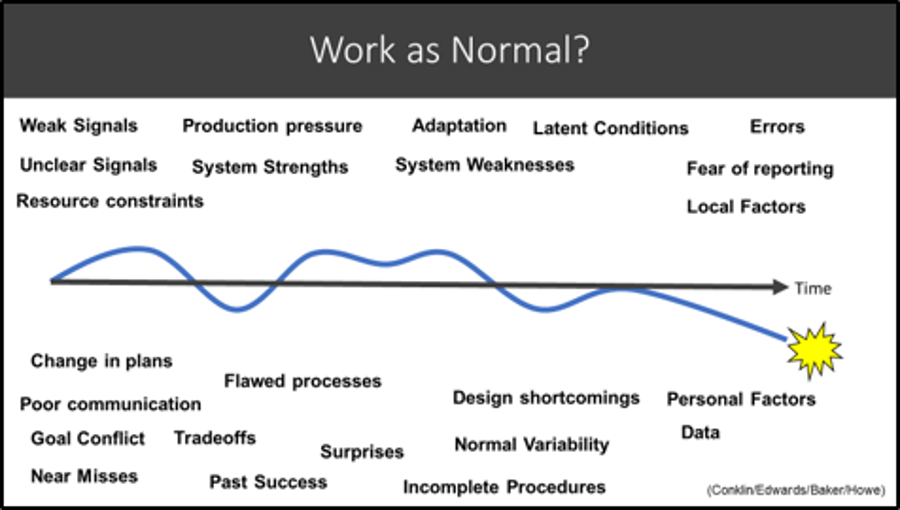
- Work As Normal – How the workforce normally undertakes work.
To achieve organisational risk reduction, the depth of information collected should be sufficient to discover systemic organisational issues.
For all levels of Event Investigation, a systematic process shall be followed regardless of the investigation analysis tool employed. The specific steps and processes to follow in the investigation will depend on the methodology utilised. Essential elements that need to be considered in all levels of investigations are Work as Intended, Work as Normal and Work as Happened.
Event Insight
An Event Insight is a tool that uses generative questions designed to learn about an event and the context of the work. It is a quick interview-style activity that can be conducted by a HY Supervisor or similar.
The Event Insight includes the following questions:
- Describe the event. Walk me through what happened.
- What surprised you about the event?
- Could things have gone worse? And why did that not happen?
- When this task works well, what must go right?
- Is there anything that frustrates you with this task? (E.g. Out of your control, where you have to adapt)
- What could management understand better about this task?
- How can we improve the way we do this?
- Next steps: assign responsibilities for actions
Note: Step 8 may be populated after the worker interview has concluded.
Blueline Investigation
Blueline Investigations are to be conducted by trained facilitators as identified in the Event Learning Process table. The Blueline Investigation process includes establishing a timeline built from a multi-layered sequence of events looking at Work-As-Intended, Work-As-Normal, and Work-As-Happened. This timeline is illustrated in the Blueline Investigation Timeline template.
This process identifies the conditions that contribute to the differences between the three and identifies issues that require corrective action.
When conducting the investigation, the trained facilitator is to consider available information such as Event Debriefs, relevant documentation, and insights from interviews to complete the Blueline Analysis.
Lead Investigators are to ensure that the information-gathering process is sufficiently deep to either capture or rule out organisational factors such as management of change, risk assessments, etc.
Upon completing all High-Level investigations, the Lead Investigator is to complete a Blueline Gap Analysis. The process can be conducted however the Lead Investigator sees fit to suit the situation or personal learning style.
The analysis aims to identify the differences between Work-As-Intended, Work-As-Normal and Work-As-Happened. These conditions contribute to those differences and the impact the differences resulted in.
If applicable, the HRW Check In process can be utilised to look at the effectiveness of controls.
Workers Learning Team
A Workers Learning Team is a small group workshop with a diverse group directly involved in a work activity or with helpful information concerning an event. The purpose of a Workers Learning Team is to learn and improve our operational knowledge. Applying Workers Learning Teams to improve our work can result in stronger safeguards and improved quality and efficiency.
Similar to the role of the Accountable Manager for Blueline Investigations, the most relevant manager is responsible for sponsoring the Worker Learning Team to give traction to any insights or actions recommended by the team – They are known as the Sponsor. Depending on the scope of the Workers Learning Team, this may be the person with authority over a workgroup, workplace, business function, region, or State.
The Sponsor shall ensure that an approved facilitator is appointed and the resources required to undertake the Workers Learning Team are provided. This includes time and workers.
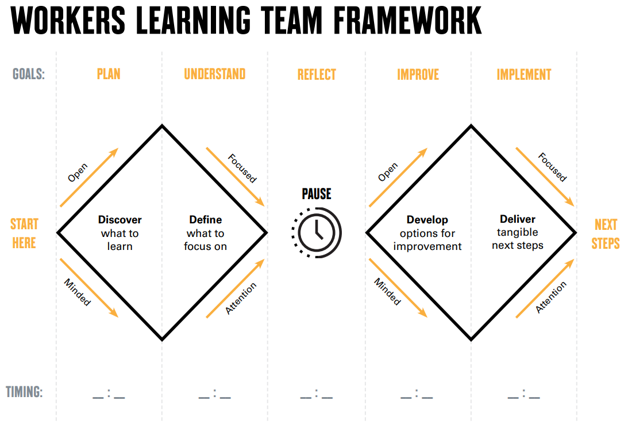
Workers Learning Teams follow a standard process.
When planning the Workers Learning Team, the scope is defined, (not too broad and not too narrow) and the right people must be included in the session – a cross-section of about 5 to 8 people closest to the work.
SESSION 1
Plan: The team discovers how work gets done by discussing conditions that may influence how work is done and where they may drift from the procedure.
Understand: The group understands the circumstances and defines what to focus on
Reflect:
Following session 1, the team takes time to pause and reflect on what they’ve learned before returning for session 2. Ideally, this break will take place overnight, but this can differ based on the group’s availability. New insights can be learned and shared in the next session.
SESSION 2
Improve: Further insights are discovered following the reflection time. Insights are categorised into common themes and the team develops options for improvement.
Implement: Improvements are identified according to the team’s sphere of control, influence or concern. The team agrees on what to deliver as a priority.
Following the Workers Learning Team, the facilitator is to prepare a Learning Team Report for the group to provide to the Sponsor with recommended actions. The Sponsor is to notify the learning team members of the decision to implement or not implement the team’s recommendations.
The report is to include:
- The Context (This is background information for the learning team. It could include organisational context and the trigger for the learning team.)
- Key Themes
- Recommendations
EVENT LEARNING REPORT
Once the Event notifications are complete and following the Event Investigation, the Event Learning Report is to be completed using the Event Learning Report Template.
Records relating to the Event are to be included as an attachment to the Event Learning Report. This includes but is not limited to:
- Photographs
- Drawings/markups
- SWMS if applicable
- Induction Records
- Training Records/Competencies
- Witness Statements
- WHS Regulator Reports (if required)
The Event Learning Report is to include a de-identified summary of details that describe the event, outcome, and actions. The purpose of this is to be able to share with other teams and projects for organisational learning.
Event Learning Reports are to be peer-reviewed by an independent facilitator who is trained and experienced in the methodology used. The reviewer is to ensure that the investigation applied the methodology correctly, and that the report is factual and demonstrates a restorative just culture. The reviewer is to complete the Investigation Quality Checklist.
The peer-reviewed Event Learning Report is to be presented to the Accountable Manager to review the report and its recommendations. The Accountable Manager may request the facilitator review the content of the report; however, any review of content shall be solely at the facilitator’s discretion. The final report will be forwarded to the Accountable Manager for action.
Actions
On receipt of the final report, the Accountable Manager is to review the recommendations and implement actions they deem appropriate. Actions are to be discussed with any relevant risk owners or stakeholders.
Once actions have been agreed upon and approved for action, they are to be raised as Observations from within the Event Learning Report entry in HammerTech. Observations are to be assigned to the relevant personnel and address the contributing factors to the Event. Any risk controls are to be developed in accordance with the Hierarchy of Controls. The Observations are to be followed up and closed out within the assigned due date.
EVENT REVIEW AND CLOSE OUT
Project Managers, Site Managers, and Senior HSE Business Partners are to review and close out Event entries and any associated Observations within HammerTech. General and Area Managers are to be kept informed of this process.
Once the report is accepted by the Accountable Manager, the completed report and any supporting documentation must be emailed to workdifferently@hansenyuncken.com.au. This inbox is monitored by the National HSEQ Systems Coordinator, who has HammerTech administration access. The National HSEQ Systems Coordinator will upload the documents to the relevant incident entry to maintain a single source of truth. (Note: The incident report includes an admin-only document upload section which is not accessible by non-administrators.)
Fortnightly Event Review and Organisational Learnings
All events are reviewed at the Fortnightly Event Review meeting, chaired by the CEO and attended by the Head of HSEQ & Sustainability and General Managers (or Area Managers, where applicable). HSE Managers may attend by exception. At each meeting, General Managers (or Area Managers in the GM’s absence) are responsible for presenting the event details and providing updates on the status of actions.
Where events contain insights that may benefit other teams or projects, organisational learnings will be identified during the review. The Event Review Team will determine which lessons should be shared more broadly and coordinate any communication through the HSE Managers, as appropriate. This may include operational teams, State Leaders, Estimating Managers, or other relevant stakeholders to support future planning, tenders, or project delivery.
Each state is responsible for ensuring relevant lessons are communicated to project teams and workgroups using suitable methods such as pre-starts, toolbox talks, or Subcontractor Coordination Meetings.
Review of Critical Events
For Critical Events, the relevant General Manager is responsible for initiating a separate close out meeting with the CEO and Head of HSEQ & Sustainability following completion of the investigation. This meeting is intended to present findings and discuss any opportunities for operational improvement. The CEO will share this information with the Board of Directors.
This close out meeting is independent of the regular Fortnightly Event Review and does not involve the broader leadership group. However, relevant updates or ongoing actions may be shared at subsequent fortnightly reviews, as appropriate. Members of the Board may attend the meeting if the status of actions for Class 1 Event are being discussed.
Where the Crisis Management and Communication Plan has been enacted, an evaluation of the business’s response is to be in accordance with the plan.
DEFINITIONS AND ABBREVIATIONS
First Aid Injury
A First Aid Injury (FAI) is a work-related injury for which the following treatment is given (regardless of whether provided by first aider or medical practitioner):
- Using a non-prescription medication at non-prescription strength
- Administering tetanus immunisations (other immunisations, such as Hepatitis B vaccine or rabies vaccine, are considered medical treatment)
- Cleaning, flushing or soaking wounds on the surface of the skin
- Using wound coverings such as bandages, Band-Aids™, gauze pads, etc.; or using butterfly bandages or Steri-Strips™ (other wound closing devices such as sutures, staples, etc., are considered medical treatment)
- Using hot or cold therapy
- Using of any non-rigid means of support, such as elastic bandages, wraps, non-rigid back belts, etc. (devices with rigid stays or other systems designed to immobilize parts of the body are considered medical treatment)
- Using of temporary immobilisation devices while transporting an accident victim (e.g., splints, slings, neck collars, back boards, etc.)
- Drilling of a fingernail or toenail to relieve pressure, or draining fluid from a blister
- Using of eye patches
- Removing foreign bodies from the eye using only irrigation or a cotton swab
- Removing splinters or foreign material from areas other than the eye by irrigation, tweezers, cotton swabs or other simple means
- Using Finger Guards
- Using massages (physical therapy or chiropractic treatment are considered medical treatment)
- Drinking fluids for relief of heat stress
Medical Treatment Injury (MTI)
A Medical Treatment Injury (MTI) is a work-related occurrence that results in treatment by, or under the order of, a qualified medical practitioner, or any injury that could be considered as being one that would normally be treated by a medical practitioner but does not result in the loss of a full day/shift.
MTIs include physical injuries as well as instances such as where a worker experiences psychological stress due to witnessing a traumatic event or being a victim of bullying, or if they required medical attention due to migraines caused by exposure to chemicals or gas. A qualified medical practitioner is defined as a person with a medical degree. The following would normally be considered medical treatment:
- Treatment of partial or full-thickness burns
- Insertion of sutures
- Removal of foreign bodies embedded in eye
- Removal of foreign bodies from a wound if the procedure is complicated by the depth of embedment, size or location
- Surgical debridement
- Admission to a hospital or equivalent for treatment or observation
- Application of antiseptics during second or subsequent visits to medical personnel
- Any work injury that results in a loss of consciousness
- Treatment of infection
- Use of prescription medications (except a single dose administered on the first visit for minor injury or discomfort)
- Treatment (diagnosis and evaluation) by a Psychiatrist for mental illness or stress as a result of a workplace occurrence.
The following on their own would not normally be considered medical treatment:
- Administration of tetanus shots or boosters
- Physiotherapy
- Diagnostic procedures such as X-rays or laboratory analysis, unless they lead to further treatment
- Referral to/treatment by a Psychiatrist where the diagnosis is not a result of a workplace occurrence
Lost Time Injury
A Lost Time Injury (LTI) is defined as an occurrence that results in a fatality, permanent disability or time lost from work of one day/shift or more.
LTIs exclude pre-existing conditions that weren’t sustained on the project as determined by a Medical Practitioner or specialist. Injuries that weren’t reported at the time of occurrence will be reviewed by the HSE Manager and determined on a case-by-case basis as to whether to include as an LTI.
Event – An occurrence on site that adversely impacts the health and safety of people, quality of work and building products, and impact on the environment.
Event Investigation – A structured process designed to analyse and derive lessons from occurrences (events) that impact health, safety, environmental quality, and operational standards.
Minor/Medium Harm – Relating to an actual or potential Class 2 or 3 event.
REFERENCES
- Work Health & Safety Regulation 2011 (QLD), 2012 (SA/TAS) and 2017 (NSW) – Part 12.4 Event notification
- Occupational Health and Safety Act 2004 (Victoria) – Part 5 Duties relating to Events
- AS 1885.1 – 1990: Workplace injury and disease recording standard
- Occupational Safety and Health Administration (OSHA) Standard Number 1904.7 – General recording criteria
- FSC Online WHS Report Guide (February 2020)
- Federal Safety Commission (FSC) Audit Criteria – WH15 Event Learning Activity and Corrective Action